DR MIR METAL STUDIO
Introduction & Story of Beginnings
Our team was founded by an individual with a PhD in Mechanical Engineering, together with a highly educated and experienced team of engineers, metal industry experts, and sculpture artists. Our story began about three years ago (in 2022), when we first stepped onto the path of creating artistic and industrial works by designing and building sculptures from thin layers of raw wood, as well as wooden industrial prototypes. From day one, our main motivation has been to build technical capability, unleash creativity, prove our knowledge and expertise in this field, and most importantly, compete with the leading names of this industry in various countries around the world.
Mission & Values
Our goal goes far beyond selling a decorative piece; we aim to compete internationally with the major players in this field by relying on technical knowledge and algorithmic design. The values we prioritize are:
- Intellectual property ownership by the buyer – The design and concept belong entirely to you.
- Confidentiality of the artwork – No similar piece will ever be reproduced for anyone else.
- Unique design and production for each client – Every piece is one of a kind and unmatched.
- On‑time delivery with high quality – We adhere strictly to agreed timelines without any compromise on quality.
- Fixed contract costs – Even if raw material prices rise, the final cost for you remains unchanged.
- Responsiveness and 3‑year warranty – In case of any minor damage, we support you for up to three years after delivery.
Introduction & Story of Beginnings
Our team was founded by an individual with a PhD in Mechanical Engineering, together with a highly educated and experienced team of engineers, metal industry experts, and sculpture artists. Our story began about three years ago (in 2022), when we first stepped onto the path of creating artistic and industrial works by designing and building sculptures from thin layers of raw wood, as well as wooden industrial prototypes. From day one, our main motivation has been to build technical capability, unleash creativity, prove our knowledge and expertise in this field, and most importantly, compete with the leading names of this industry in various countries around the world.
Special Products & Services
We provide complete services from concept to installation:
- 3D model design based on the client’s specific requirements – Whatever you have in mind, we turn it into an accurate digital model.
- Layered design of the 3D model – We convert the designed model into separate, manufacturable layers.
- Sourcing and supplying all project materials – From steel, aluminum, matte and mirror stainless steel to any other metal material.
- Professional installation and assembly of sculptures – Our execution team installs the piece on‑site with precision.
- Painting according to the client’s taste – Any color that suits your space is applied exactly to the components.
- Secure packaging and shipping to the client’s location – We use standard packaging and safe transport to ensure the piece arrives in perfect condition.
- Warranty and after‑sales service – Upon customer request, all our pieces are covered by a 3‑year warranty after delivery.
Mission & Values
Our goal goes far beyond selling a decorative piece; we aim to compete internationally with the major players in this field by relying on technical knowledge and algorithmic design. The values we prioritize are:
- Intellectual property ownership by the buyer – The design and concept belong entirely to you.
- Confidentiality of the artwork – No similar piece will ever be reproduced for anyone else.
- Unique design and production for each client – Every piece is one of a kind and unmatched.
- On‑time delivery with high quality – We adhere strictly to agreed timelines without any compromise on quality.
- Fixed contract costs – Even if raw material prices rise, the final cost for you remains unchanged.
- Responsiveness and 3‑year warranty – In case of any minor damage, we support you for up to three years after delivery.
Special Products & Services
We provide complete services from concept to installation:
- 3D model design based on the client’s specific requirements – Whatever you have in mind, we turn it into an accurate digital model.
- Layered design of the 3D model – We convert the designed model into separate, manufacturable layers.
- Sourcing and supplying all project materials – From steel, aluminum, matte and mirror stainless steel to any other metal material.
- Professional installation and assembly of sculptures – Our execution team installs the piece on‑site with precision.
- Painting according to the client’s taste – Any color that suits your space is applied exactly to the components.
- Secure packaging and shipping to the client’s location – We use standard packaging and safe transport to ensure the piece arrives in perfect condition.
- Warranty and after‑sales service – Upon customer request, all our pieces are covered by a 3‑year warranty after delivery.
Dr Mir Metal Parametric Sculpture Manufacturing Steps:
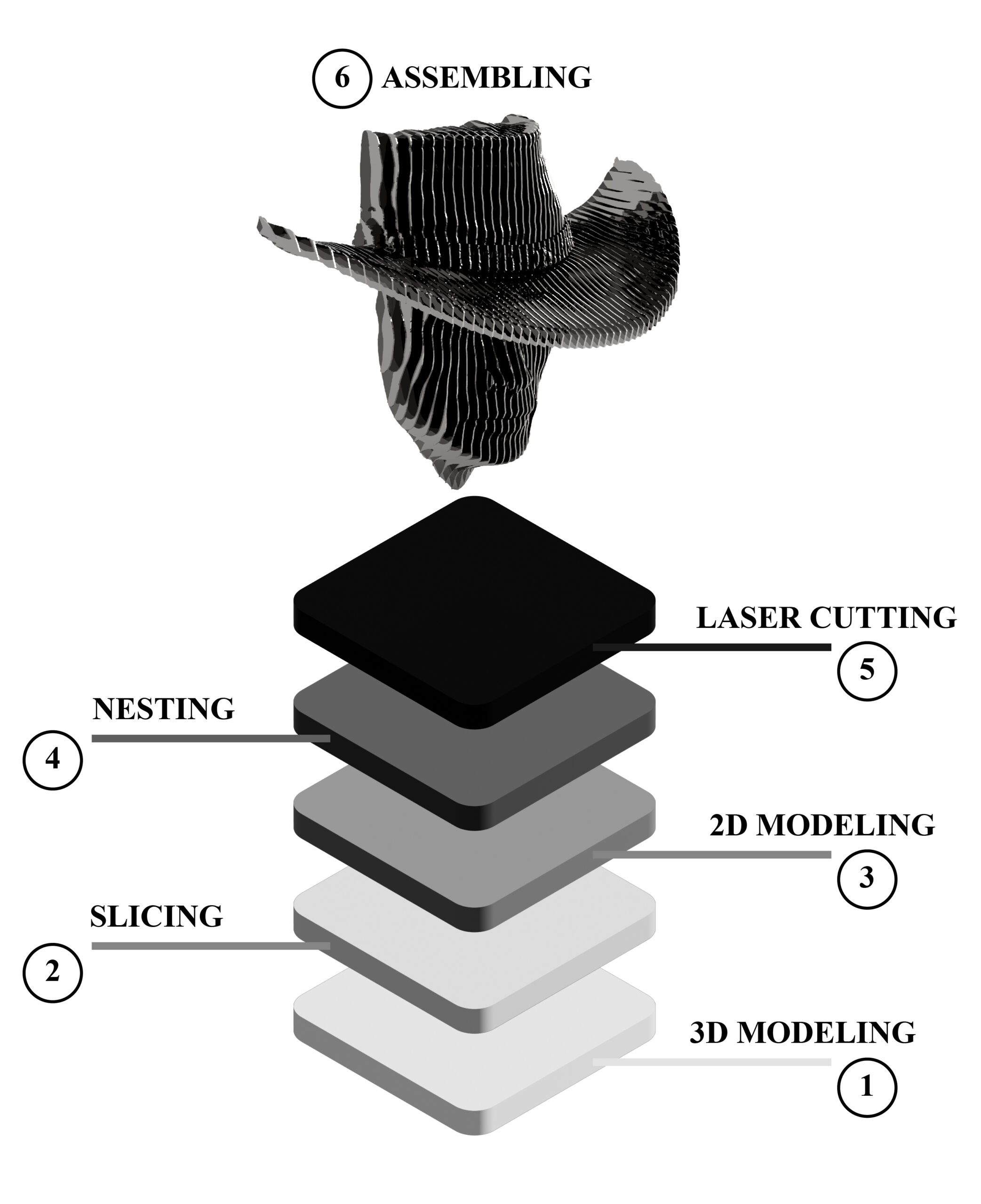
Step 1: 3D MODELING
The first and most important step is creating the desired 3D form using advanced parametric modeling software such as 3D Max, Blender, and other specialized tools in this field. In this stage, the initial design is created based on the dimensions of the space, the client’s taste, and the artist’s vision. All curves, surfaces, and volumes are defined precisely and parametrically (modifiable).
The initial 3D model is sent to the client, and feedback along with requested changes is received. This cycle (sending the model → receiving comments → applying revisions) is typically repeated several times until the final model is fully approved by the client. After final approval, the model is locked and proceeds to the next stages. All comments and different versions of the model are recorded and archived in the project file.
Step 2: SLICING
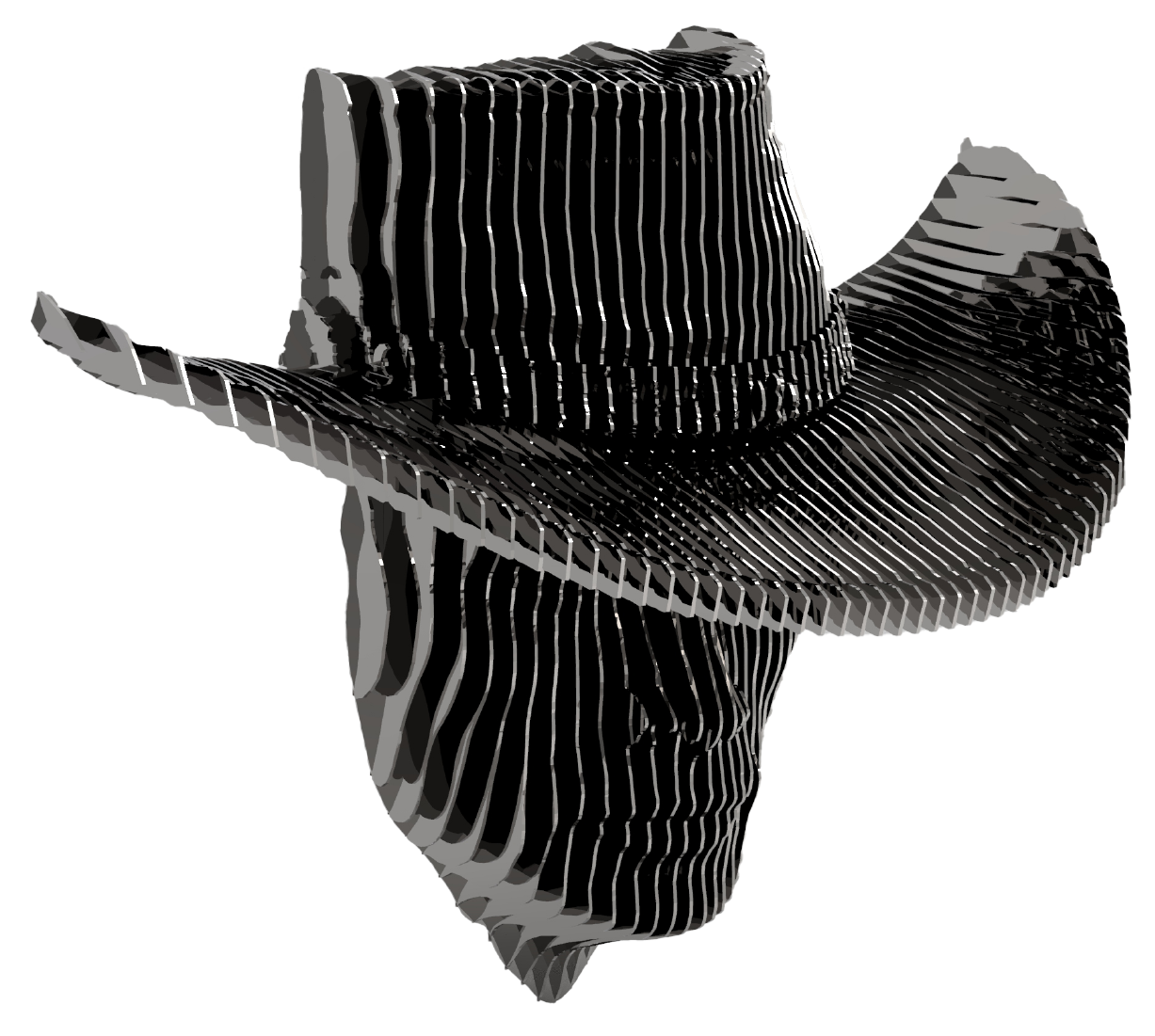
After the 3D model is completed and finally approved by the client, it is time to “slice” it into horizontal or vertical layers. The output of this stage is a set of 2D profiles (the edge of each layer). This is done using specific algorithms that divide the continuous model into a defined number of layers with a specified thickness (for example, 3mm to 30mm). The spacing between layers is also adjustable and has a direct impact on the final characteristics of the piece:
- Small spacing between layers (dense): The closer the layers are to each other, the closer and more realistic the sculpture appears to the original 3D model. In this case, the volume of the piece appears more compact and detailed. However, the number of parts and consequently the final weight of the sculpture increases, and the overall cost of the project rises.
- Large spacing between layers (spread): The farther apart the layers are, the greater the sense of lightness, transparency, and the play of light and shadow in the piece. When viewed from the front, less volume is visible, and as the viewing angle changes, the form gradually reveals itself. In this case, the number of parts and the weight of the sculpture decreases, and the final cost of the project is lower. Of course, some details of the original model are lost, and the piece appears more abstract.
Choosing the appropriate spacing between layers is always an intelligent balance between fidelity to the model, visual beauty, final weight, and project budget. Our team, considering the client’s needs and preferences, suggests the best option at this stage.
Step 3: 2D MODELING
In this stage, each layer (which is a closed contour or loop) is converted into an independent 2D part. These parts must be ready to be arranged alongside each other on the metal sheet. Holes, screws, or threads for connecting layers may also be defined on each 2D part during this step.
Important note: 2D modeling and selecting the contours is an extremely complex and time-consuming process. The contours must be prepared in a way that is perfectly suitable for laser cutting. This means that all lines must be closed and unbroken, there should be no extra lines or overlaps, and the cutting direction must be optimized.
Precision in this stage has a direct impact on the ease of final assembly and the final quality of the laser cut. Any error in 2D modeling can lead to misalignment of layers during assembly or the creation of rough and uneven edges.
Step 4: NESTING (Part Arrangement)
Now it’s time for the most intelligent part of the process. Using advanced nesting and optimization software, all 2D parts are arranged in the smallest possible space on the raw metal sheet (for example, a 2×1 meter sheet of iron or aluminum). The goal is to maximize the reduction of raw material waste (scrap) and increase cutting speed. This stage directly affects the final cost of the project.
Although advanced software is capable of automatically arranging parts, arrangement may also be done manually in addition to the computer method to achieve better optimization. The operator’s experience and precision in manual
arrangement can often reduce waste even more than the software output.
Determining the distance between parts is also particularly important because the proper distance ensures that parts do not damage each other during cutting while making the most efficient use of the metal sheet.
At this stage, the balance between automatic arrangement (high speed) and manual arrangement (greater precision and waste reduction) is determined based on the volume of parts and the project budget. Our team is skilled in both methods. The output file of this stage is delivered to the laser cutting machine operator.
Step 5: LASER CUTTING
Once the nested file is ready, the parts are cut with very high precision using a laser cutting machine. The advantage of laser cutting is smooth edges, no burrs, and no need for secondary finishing. The type and thickness of the sheet (steel, stainless steel, aluminum, iron, etc.) determines the power and speed parameters of the laser. At the end of this stage, all layers are ready to be separated from the main sheet.
Step 6: ASSEMBLING
Now the cut layers must be assembled on top of each other in a specific order. At this stage, the sculpture transforms from a set of scattered sheets into a unified and coherent three-dimensional volume. Assembling is one of the most sensitive and time-consuming steps of the manufacturing process, requiring great patience and care.
Each part must be placed in its exact position, and the order of the layers must be free of any errors. This is done slowly and with high precision to ensure no pressure is applied to the parts and that the final form perfectly matches the 3D model.
All assembly steps are carried out in a clean environment, free from any dust, grease, or contamination, so that no stains or scratches are created on the surface of the parts and the final quality of the piece is preserved.
Important Note
All these stages are carried out under the direct supervision of our engineering team, and each project has its own technical documentation. If you have any questions about any stage, our consulting team is ready to assist you.
International Presence & Export
We are proud to export our parametric metal sculptures to the Persian Gulf countries (such as the UAE, Qatar, Oman, Kuwait, and Bahrain) as well as European countries. Our ability to comply with international standards for packaging, shipping, and customs, together with our outstanding track record in cross‑border projects, demonstrates our commitment to global quality. Even if you are outside Iran, you can still benefit from our unique design and manufacturing.
Contact Us
We are ready to turn your ideas into tangible, eye‑catching works of art. Whether you want a unique art piece for your personal space or are looking for a special project for your collection, our team will be with you from start to finish. Just get in touch with us – the initial consultation is free, and we will be honored to accompany you in creating a lasting work of art.